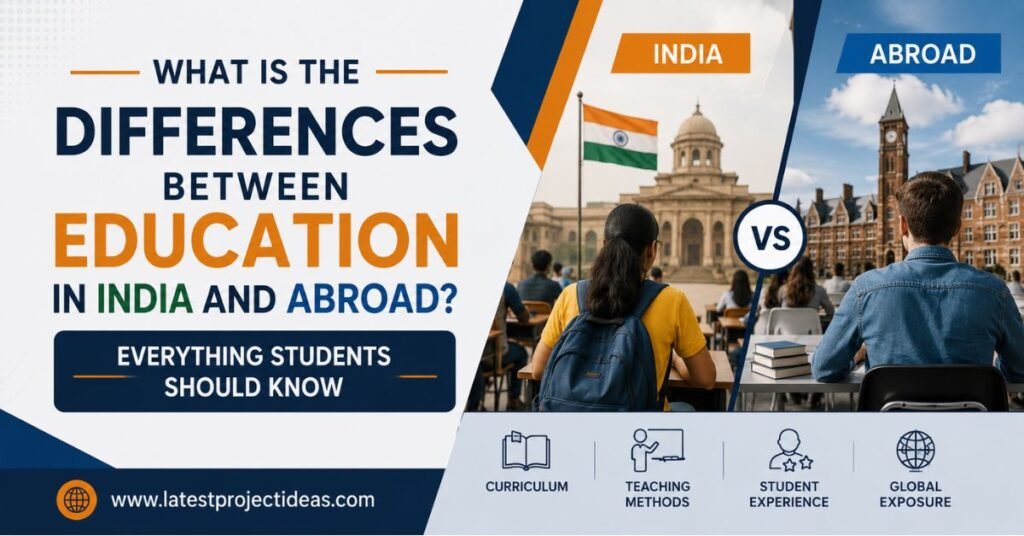
Education plays a central role in shaping economic growth, social development, and personal identity. Yet education systems vary widely around the world. Understanding the differences between education in India and abroad helps students, parents, and policymakers make informed decisions about learning paths and future opportunities.
India has one of the largest education systems in the world with more than 260 million students enrolled according to UNESCO Institute for Statistics. Countries abroad, especially in regions like North America, Europe, Australia, and East Asia, have different structures, teaching cultures, and outcome-based models. The comparison is not about which system is better. Rather, it is about how each one works, what advantages each offers, and what lessons India can adopt to improve its education ecosystem.
Why Compare Education Systems?
Comparing systems helps identify:
- Strengths that can be adopted
- Gaps that require improvement
- Policies that work better in large or diverse populations
- Realistic expectations for students planning to study abroad
- Opportunities to redesign curriculum in India
UNESCO and OECD regularly compare global education outcomes. Their studies show that systems that provide flexibility, critical thinking, and strong teacher training perform better in learning outcomes.
Overview of the Indian Education System
India’s education system is structured through primary, secondary, and tertiary levels. It follows national policies such as the National Education Policy (NEP) 2020. Key characteristics include:
- Large student population
- Competitive board exams
- Emphasis on academic scores
- Growing but uneven infrastructure
- Limited teacher-student ratio in many regions
- Urban and rural performance gaps
NCERT, CBSE, and state boards guide textbooks and examinations. The NEP 2020 aims to shift toward skill-based learning and reduce rote memorization.
Also read: How Can Teachers Create a Classroom Environment That Reduces Stress and Supports Well Being?
Overview of Education Abroad
Education abroad varies by country. Common patterns in regions like the United States, Canada, Finland, Germany, and Australia include:
- Flexible curriculum choice
- Project-based learning
- Focus on creativity, collaboration, and soft skills
- Smaller class sizes
- Strong teacher training requirements
- Equal emphasis on sports, arts, and academics
OECD PISA rankings show that countries with high investment in teacher training and experiential learning demonstrate stronger student performance.
What is The Differences Between Education in India and Abroad?
Below are key areas where the systems differ. These explanations remain factual and based on global education research.
Curriculum Structure and Flexibility
In India, most students follow a fixed curriculum based on CBSE, ICSE, or state boards. Subjects are pre-selected until grade ten. After schooling, many students enter common pathways such as engineering, medicine, and commerce due to competitive pressures.
Education abroad often allows students to choose subjects early. For example, American high schools offer electives such as psychology, digital media, and performing arts. Finland offers interdisciplinary modules where subjects overlap.
Flexibility in curriculum abroad helps students discover strengths earlier. India’s structure offers discipline but may limit early exploration.
Teaching Methods and Classroom Culture
India traditionally uses teacher-centered models where teachers speak and students listen. Rote memorization remains common in board exam preparation. However, urban schools are increasingly integrating activity-based learning.
Education abroad uses student-centered learning. Lessons include debates, group projects, field assignments, and lab-based inquiry. The classroom culture encourages questions and disagreement.
The Education Endowment Foundation found that active learning methods improve retention and problem-solving. This difference is one of the most significant in how learning is experienced.
Assessment and Exams
Indian education heavily relies on written exams and board results. Academic success is measured through marks. Pressure during board exams is high according to NCERT’s adolescent report.
Abroad, assessment is spread throughout the year. It includes:
- Presentations
- Projects
- Assignments
- Group work
- Practical demonstrations
Marks are not the only measure. Holistic grading includes participation and creativity. This reduces exam anxiety.
Teacher Training and Status
Teacher training in India varies by region. The teacher-student ratio in many government schools remains high. Teachers often handle administrative duties beyond teaching.
Abroad, becoming a teacher usually requires professional degrees, practice-teaching internships, and certifications. Teacher status is comparable to other respected professions in countries like Finland or Canada.
OECD’s Teacher Policy Review highlights that strong teacher training correlates with better student outcomes.
Infrastructure and Learning Resources
India has world-class institutions in cities but struggles with rural gaps. Issues include lack of digital access, limited lab equipment, and inconsistent school facilities.
Education abroad often includes modern classrooms, digital tools, sports infrastructure, library spaces, and disability-inclusive designs. Investment per student is higher. For example, OECD reports that Nordic countries invest nearly twice as much per student as developing countries.
However, India’s EdTech sector is rapidly expanding. Platforms such as DIKSHA and National Digital Library offer digital learning resources that reduce the gap.
Focus on Skill Development
India is shifting toward skill education through NEP 2020. Yet implementation remains gradual. Soft skills, communication, teamwork, and problem-solving are not deeply embedded in most classrooms.
Abroad, skill development is a core pillar. Countries link school learning with real-world internships and apprenticeships. Germany offers dual education, pairing study with industry experience.
Students abroad graduate with stronger workplace readiness.
Student Well Being and Mental Health
Indian schools seldom include structured emotional support. Exam stress is reported as high across secondary students. UNICEF notes rising stress levels among Indian adolescents due to academic pressure.
Abroad, school counselors, mental health classes, and well being programs are integrated into daily routine. Many schools include weekly emotional check-ins and mental health support services.
This difference influences confidence levels and student happiness.
Cost of Education
India offers more affordable education at school level. Government-run institutions provide low fee or free schooling. Private schools vary widely in cost.
Abroad, school education may be funded by government. However, higher education abroad can be expensive. Tuition, accommodation, and living costs are major considerations. Scholarships are available but competitive.
Understanding the cost difference helps students make realistic study plans.
Parent Involvement
In India, many parents act as academic supervisors at home, helping with homework and exam preparation. Parent-teacher meetings occur but are often formal.
Abroad, schools encourage ongoing dialogue. Parents help through volunteering, attending workshops, and joining school committees. This builds shared responsibility.
Parental involvement impacts learning according to Harvard Family Research Project.
Advantages of Education in India
- Strong theoretical base
- Competitive environment builds discipline
- Affordable options
- Strong networks in engineering and medical fields
- Respect for teachers in many communities
India produces large numbers of STEM graduates. This shows that the system builds academic endurance and subject depth.
Advantages of Education Abroad
- Emphasis on creativity and problem-solving
- Early subject choice
- Strong mental health support
- Better infrastructure and facilities
- Global perspective and cultural exposure
Students studying abroad often return with communication skills, confidence, and international experience.
What India Can Learn from Global Systems?
India can benefit from:
- Stronger teacher training
- Flexible curriculum design
- Reduction in exam pressure
- Emotional well being programs
- Apprenticeship models and industry links
- Smaller class size in early years
NEP 2020 is already moving India in this direction.
What Other Countries Can Learn from India?
Abroad systems can learn from India’s:
- Respect for education as a cultural value
- Family-based motivation
- Mathematical rigor
- Student resilience and hard work
Cross-exchange of ideas can help build better systems for all.
Should Students Study Abroad?
The decision depends on personal goals, financial ability, career plans, and learning preferences. Studying abroad is not a guarantee of success. Many Indian students excel within the Indian system. Many succeed abroad as well.
Students should ask:
- What kind of learning environment suits me
- Do I want exposure or affordability
- Do I need hands-on experience or academic rigor
Counseling from trusted school advisors helps make better choices.
Also read: States of Matter Project Ideas for School Students
Conclusion
Understanding the differences between education in India and abroad is not about proving one is superior. It is about identifying what works and what can be improved. India holds strength in theory, discipline, and exam-based preparation. Abroad systems offer flexibility, skill-based learning, teacher support, and emotional well being.
A healthy education future for India lies in combining the best practices of both worlds. When policy, teachers, parents, communities, and students work together, India can create a balanced system where knowledge, creativity, character, and opportunity work hand in hand.
Frequently Asked Questions
Indian education focuses more on academic scores and exams, while many international systems emphasize creativity, practical learning, critical thinking, and skill development.
Neither option is universally better. The right choice depends on your career goals, budget, preferred learning style, and whether you value flexibility or academic rigor.
Many foreign education systems allow students to choose subjects, explore electives, and participate in project-based learning, helping them discover interests earlier.
India provides a strong theoretical foundation, affordable education options, competitive academic training, and excellent preparation for STEM-related careers.
India can adopt more skill-based learning, improved teacher training, stronger mental health support, flexible curricula, and reduced dependence on high-pressure exams.

Hi, I’m Emma Caldwell, the founder of LatestProjectIdeas.com. With over 3+ years of experience in educational content, project research, and academic resources, I am passionate about helping students, researchers, and innovators discover valuable ideas. Our website provides science project ideas, school projects, engineering projects, research topics, and creative project inspiration for learners of all levels. Every article is carefully researched and designed to be practical, informative, and easy to understand. Our mission is to make learning, innovation, and project development more accessible for everyone.