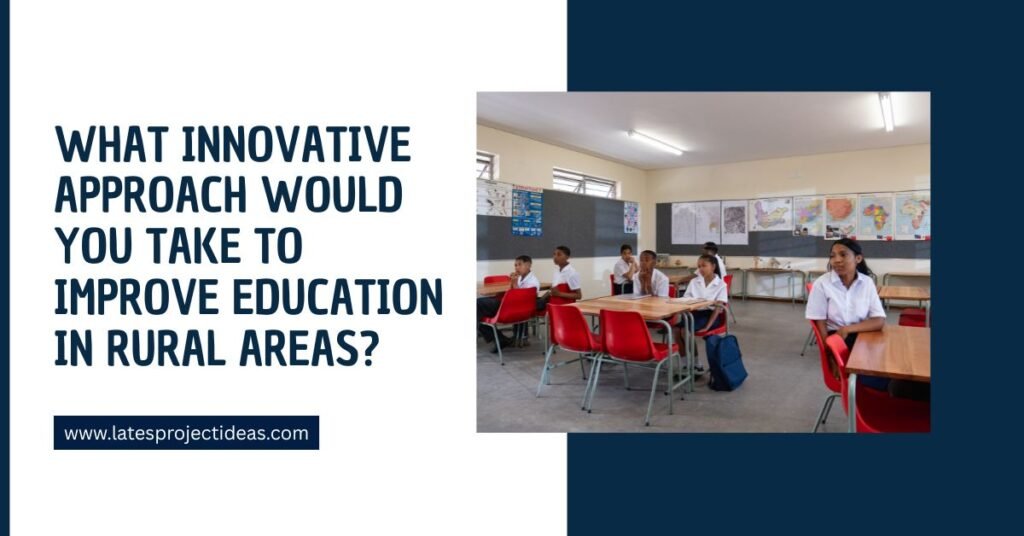
Education is a fundamental right. However, access to quality learning still varies widely between urban and rural regions. Rural communities often face challenges such as limited school infrastructure, teacher shortages, low availability of digital tools, long travel distances, and weak economic conditions.
UNESCO reports that rural children in several countries experience a learning gap due to lack of resources and support systems. The World Bank also identifies teacher absenteeism, learning poverty, and lack of basic school environments as barriers in rural education.
This creates an important question for parents, teachers, policymakers, and students. What innovative approach would you take to improve education in rural areas? This blog explores realistic, research-supported answers. It offers ideas that schools and governments can implement through partnerships and community involvement.
Understanding Challenges in Rural Education
Before identifying solutions, it is essential to understand why the problem exists. Challenges in rural schooling are multi-layered. Some common issues include:
- Inadequate school buildings and learning spaces
- Shortage of trained teachers
- Limited electricity and internet connectivity
- Students walking long distances to reach school
- Low family literacy levels
- Limited parental involvement due to work demands
- Lack of exposure to career options and skill-based learning
These challenges are supported by findings from UNICEF and NCERT reports on rural learning environments. Understanding these realities helps us shape solutions that fit the ground situation.
Also read: CBSE Class 12 Physics Investigatory Project Topics
What Innovative Approach Would You Take to Improve Education in Rural Areas?
Innovative approaches must be practical, scalable, and cost-effective. Solutions must work even where electricity, internet, or teacher support is low. Real innovation is not only about technology. It is about rethinking how learning can happen using community strength, local culture, and simple resources.
Below are approaches that combine research-based strategies with rural practicality.
Mobile Learning Classrooms for Remote Villages
Some rural children live too far from the nearest school. A mobile classroom, using a renovated bus or van equipped with books, whiteboards, and learning kits, can reach these areas. This idea is already in use in parts of India, Kenya, and Brazil. For example, the Indian program called School on Wheels brings teachers and resources to underserved students. UNESCO reports show that mobile education can increase enrollment and reduce dropout rates when it is consistent.
Community-Based Teacher Support and Training
Many rural schools lack skilled teachers. Instead of waiting for teachers to be transferred, communities can support learning by training local educated youth as classroom assistants. The Pratham Foundation in India runs a community-teaching model where trained volunteers help improve literacy and numeracy. This reduces student-teacher ratio and keeps learning stable.
Schools should pair local volunteers with trained teachers through hybrid teaching. This ensures students do not depend on one teacher. It also creates local employment and a sense of ownership inside the village.
Blended Learning with Low-Cost Technology
Technology helps when used wisely. In places with low or unstable internet, offline digital learning can still make a difference. Schools can use:
- Tablets with pre-downloaded lessons
- Solar-powered smart TV for group learning
- Offline educational apps for math and language
- Radio-based educational programs for low-tech communities
The World Bank recognizes blended learning as a transformative tool for remote education when it is paired with teacher support. The goal is not to replace teachers. It is to support them and expand learning beyond textbooks.
Learning Through Local Skill Integration
Education becomes meaningful when it connects to life. Rural children can learn through local skill-based activities such as farming, pottery, weaving, carpentry, and dairy management. Linking subjects to local life improves problem-solving and creativity. For example:
- Mathematics through crop measurement and seed counting
- Science through soil testing and composting experiments
- Language through storytelling using village history
- Social Science through learning from elders about local governance
This approach is supported by NEP 2020, which calls for vocational learning and experiential education in schools.
School-Community Partnerships
To sustain educational improvements, the entire community must become part of the learning ecosystem. Schools can run:
- Monthly parent involvement workshops
- Village education committees
- Community book donation drives
- Open learning events where children showcase projects
Research from Harvard Graduate School of Education shows that community involvement increases student performance and long term attendance. Rural parents often value education but lack time or confidence to participate. Schools must create positive and welcoming environments to include them.
Training Teachers in Rural-Focused Pedagogy
Improving rural education requires support for teachers. Many educators receive general training, but few programs focus on rural-specific needs. Governments and organizations should provide:
- Emotional training to handle multi-grade classrooms
- Tools for teaching without textbooks or devices
- Strategies for managing large mixed-age groups
- Methods for teaching outdoors or inside temporary spaces
Studies from UNESCO Teacher Task Force show that teacher-training has one of the strongest impacts on learning outcomes when adapted to local context.
Nutrition and Health Support Programs
Children who are hungry or unwell struggle to learn. In many villages, schools serve as the only location where children can access daily meals. The Mid-Day Meal Scheme in India is one example. Reports by UNICEF show that school meal programs increase attendance and improve focus. To innovate further, communities can pair meals with:
- Kitchen gardens maintained by students and volunteers
- Nutritional awareness classes
- Clean drinking water access programs
Such initiatives help parents and teachers see school as a center of wellbeing rather than only academics.
Transport and Access Solutions
If a child walks long distances to reach school, learning becomes difficult. Community bicycles, shared school vans, and government-supported transport services can reduce absence. Accessibility is physical, and improving it directly increases enrollment. Innovations can be simple and low-cost, such as partnering with local drivers or using bicycles funded by non-profits.
Bringing Real-Life Career Awareness to Rural Students
One of the biggest barriers rural students face is lack of exposure. They often do not know what careers exist outside their village. Schools can invite professionals, farmers, shop owners, nurses, and entrepreneurs to speak to students. A study by OECD on career readiness found that early exposure to real work improves long term employment outcomes.
Career fairs, role-play, field visits, and video calls with mentors can give rural children the chance to dream bigger and also value their local skills.
Using Peer Learning and Mentorship
Students often learn faster through peer collaboration. Schools can use:
- Older students teaching younger students
- Group assignments and discussions
- Leadership clubs
- Buddy systems
Peer mentorship builds confidence, improves social skills, and creates a supportive culture. Research in the International Journal of Education supports peer tutoring as a low-cost and effective intervention.
Building Play and Creativity in School Culture
Learning should not be limited to rote memorization. Schools can use art, music, drama, and sports to make education enjoyable. Creative exposure builds emotional resilience and reduces stress. UNICEF reports that play-based learning improves primary school attendance and overall mental development.
Rural children benefit especially because they often face household responsibilities at young ages. School should be a place where they feel inspired and free to express themselves.
How to Finance Innovations in Rural Education
Funding is a realistic barrier. Innovation becomes possible when there is a plan for cost and partnership. Schools can explore:
- Corporate social responsibility partnerships
- NGO collaborations
- Village education committee funds
- Government grants
- Community volunteer resources
The purpose is not to wait for funding but to start with simple, achievable actions that build trust and attract support.
Step by Step Action Plan for Schools
Based on the ideas above, here is a simple plan schools can follow:
- Identify the biggest challenge in the local area
- Conduct a meeting with teachers, parents, and community leaders
- Choose one or two small innovations to start
- Track attendance, performance, and student happiness
- Share results and build partnerships to expand the idea
Progress does not require perfection. It requires consistent effort.
Also read: Quantum Computing Project Ideas for Beginners to Experts
Conclusion
The question, what innovative approach would you take to improve education in rural areas, is about more than technology or modern tools. It is about dignity, inclusion, and understanding the realities that rural learners face each day.
Innovation must match context. A tablet without electricity is useless. A teacher without support cannot create change. But when communities join hands, when learning becomes linked to life, and when teachers receive training and respect, rural education transforms.
Rural classrooms are full of potential. With mobile learning, blended teaching, community involvement, skill-based learning, nutrition support, teacher development, and career exposure, schools can create opportunities that shape the future for generations.

Hi, I’m Emma Caldwell, the founder of LatestProjectIdeas.com. With over 3+ years of experience in educational content, project research, and academic resources, I am passionate about helping students, researchers, and innovators discover valuable ideas. Our website provides science project ideas, school projects, engineering projects, research topics, and creative project inspiration for learners of all levels. Every article is carefully researched and designed to be practical, informative, and easy to understand. Our mission is to make learning, innovation, and project development more accessible for everyone.